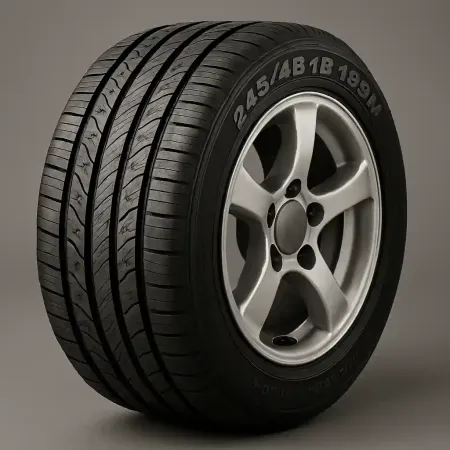
What Do the Numbers and Letters on a Tire Mean?
When you look at the sidewall of a tire, you’ll notice a series of numbers and letters such as P205/60R17 91 H M+S. While it may look like a complicated code at first, it actually contains essential information about the tire’s size, load capacity, speed rating, and type of use.
In this article, we’ll explain what each part of the code means, how to interpret it, and why it’s important to understand when replacing your tires or checking compatibility.
📌 What Do the Numbers on a Tire Mean?
Let’s use this example:
Example: P205/60R17 91 H M+S
-
Tire Type – “P”
-
“P” stands for Passenger, meaning the tire is designed for passenger vehicles (cars, light trucks, SUVs).
-
Other designations include:
-
LT (Light Truck) → Pickup trucks and cargo vehicles.
-
ST (Special Trailer) → Trailers.
-
No letter usually means a European metric tire.
-
-
-
Tire Width – “205”
-
This number indicates the tire’s width in millimeters, measured from sidewall to sidewall.
-
In this case, the tire is 205 mm wide.
-
-
Aspect Ratio (Profile) – “60”
-
This is the percentage of the tire’s sidewall height compared to its width.
-
Here, 60% of 205 mm = about 123 mm sidewall height.
-
A lower number (e.g., 45) = low profile (sportier).
-
A higher number (e.g., 70) = taller profile (more comfortable).
-
-
Construction – “R”
-
Indicates the internal structure of the tire.
-
“R” = Radial, the most common type today.
-
Less common types:
-
D or no letter = Bias Ply (Diagonal).
-
Bias-belted = Hybrid of bias with reinforcements.
-
-
-
Rim Diameter – “17”
-
Measured in inches, this number shows the size of the wheel rim the tire fits.
-
Here, it fits a 17-inch rim.
-
-
Load Index – “91”
-
Shows how much weight the tire can safely carry at the correct pressure.
-
91 = 615 kg (1,356 lbs) per tire.
-
For total vehicle capacity:
615 kg × 4 tires = 2,460 kg.
-
-
Speed Rating – “H”
-
Indicates the maximum safe speed the tire can sustain without failure.
-
H = 210 km/h (130 mph).
-
Other examples:
-
T: 190 km/h (118 mph)
-
V: 240 km/h (149 mph)
-
W: 270 km/h (168 mph)
-
-
Note: This doesn’t mean you should drive at these speeds—it only shows the tire’s structural capability.
-
-
M+S Rating (Mud and Snow)
-
“M+S” or “M&S” indicates the tire has improved traction in mud and light snow.
-
It is not a substitute for a true winter tire (which has the ❄️ mountain symbol) but is more versatile than a summer tire.
-
-
Other Common Codes
-
🔹 LI (Load Index) – Sometimes repeated for emphasis.
-
🔹 PR (Ply Rating) – Number of internal layers.
-
More common in truck, industrial, or agricultural tires.
-
Examples:
-
6 PR = stronger, for heavy-duty use.
-
4 PR = lighter-duty use.
-
-
-