The Crankshaft
The crankshaft is one of the most important components inside an internal combustion engine. Its main function is to transform the linear motion of the pistons into rotary motion, which is ultimately transmitted to the vehicle’s wheels. Although it often goes unnoticed, this component is considered the mechanical heart of the engine.
What is the crankshaft?
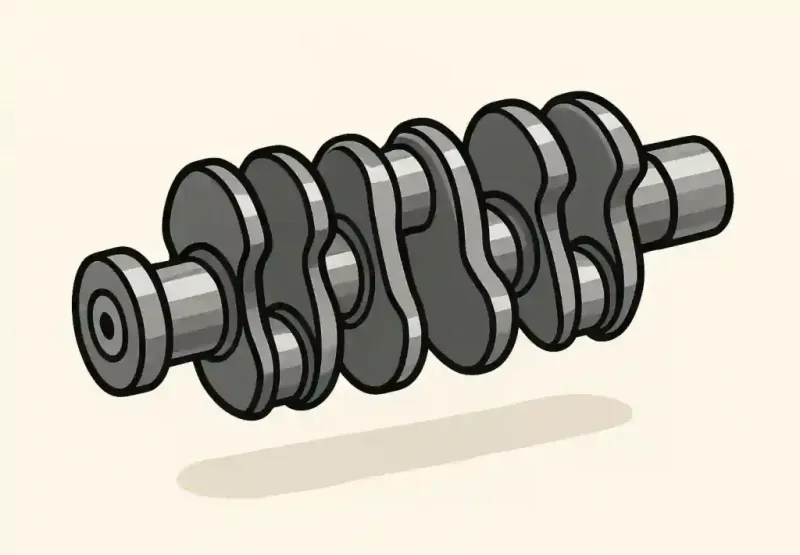
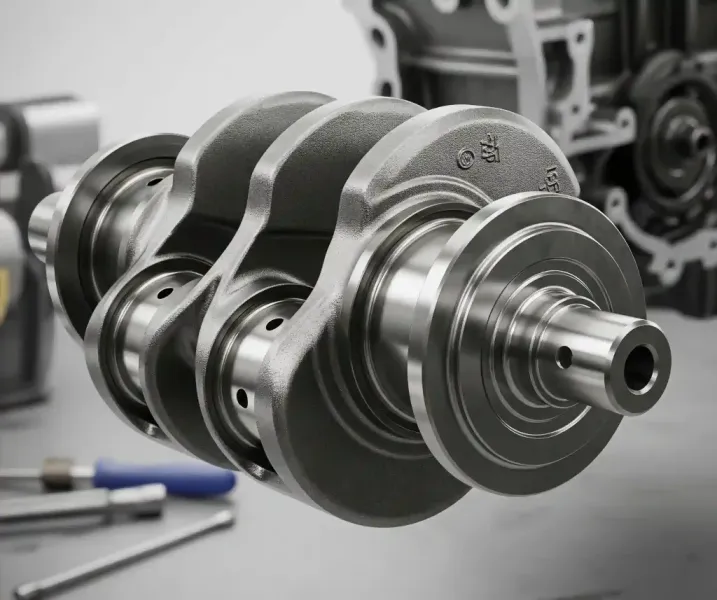
The crankshaft is a metallic shaft with an irregular shape located at the bottom of the engine, inside the block. It is designed with journals (supports), crank arms, and counterweights that help balance motion and reduce vibrations.
It is generally manufactured from forged steel or nodular cast iron to withstand high pressures and temperatures, since it constantly operates under extreme stress.
Main functions
-
Convert motion: Transforms the reciprocating motion of the pistons into continuous rotation.
-
Transmit power: Connects to the flywheel, gearbox, and finally to the wheels.
-
Maintain balance: Its counterweights reduce vibrations and improve engine stability.
-
Drive auxiliary components: Through pulleys and gears, it transfers motion to elements such as the oil pump, alternator, and timing system.
Parts of the crankshaft
-
Main journals: Shafts on which the crankshaft rotates, supported by bearings.
-
Connecting rod journals (crankpins): Connection points with the connecting rods, which transmit force from the pistons.
-
Counterweights: Masses designed to balance forces and reduce vibrations.
-
Ends: One connects to the flywheel, and the other to the timing pulley.
Types of crankshafts
-
Single-piece: The most common type in automobile engines.
-
Multi-piece: Used in large engines, such as marine or industrial engines.
-
With or without counterweights: Depending on balancing requirements.
Common failures
The crankshaft is a robust part, but it can develop problems due to wear or poor lubrication:
-
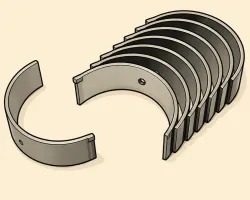
Bearing wear.
-
Cracks or fractures.
-
Imbalance.
-
Scoring or scratches on journals.
When it fails, symptoms include metallic noises, loss of oil pressure, and abnormal vibrations.
Importance in the engine
Without the crankshaft, the engine could not generate useful motion. Its precision in design and strength ensure efficient and long-lasting vehicle operation. It represents the link between the energy generated by combustion and the movement of the wheels.
In summary, the crankshaft is the backbone of automotive mechanics. Proper maintenance, along with a reliable lubrication system, is key to the engine’s lifespan.