In the automotive world, screws, nuts, and bolts are fundamental elements for the assembly and safety of a vehicle. Although they often go unnoticed, they are responsible for securing critical components such as wheels, the engine, or the suspension. Knowing their types, sizes, and thread systems is essential for both maintenance and repair.
1. Difference between screw, bolt, and nut
-
Screw: A threaded element designed to be fastened into a hole with an internal thread (such as an engine block or a cover).
-
Bolt: Similar to a screw, but its main function is to pass through two pieces and be secured with a nut at the end.
-
Nut: A piece with an internal thread that couples with the bolt to immobilize and maintain a firm connection.
2. Types of screws and bolts in a vehicle
-
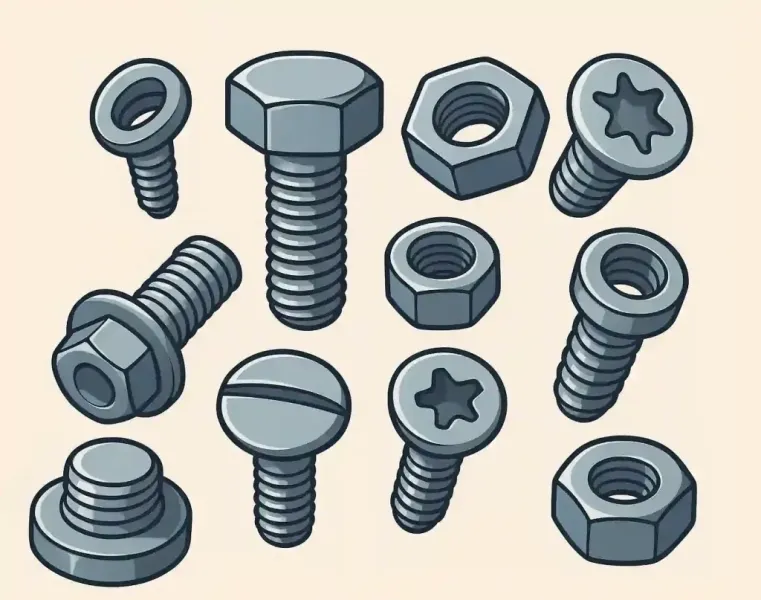
Hexagonal: The most common in chassis and engine, tightened with an open-end wrench or socket.
-
Allen (hex socket head): Used in precision parts or tight spaces.
-
Torx or star: Very common in modern automotive industry for offering more contact surface and preventing head stripping.
-
Self-tapping: Designed to fasten directly into metal or plastic parts without a pre-made thread (common in interiors and bodywork).
-
Wheel bolts or lug nuts: Specific bolts that secure the rims to the wheel hub.
-
High-strength bolts: Used in suspension, cylinder heads, and transmissions, made from high-alloy steel.
3. Materials and strength grades
Bolts and screws are mainly made of carbon or alloy steel, heat-treated to withstand tensile and shear stress. In automotive use, standards include:
-
Class 8.8, 10.9, or 12.9 (ISO standard): Indicate tensile strength and yield limit.
-
In critical applications such as cylinder heads or suspension, 10.9 or 12.9 bolts are used because they can withstand higher loads.
4. Types of threads
The thread is the most important detail in a screw or nut, as it defines compatibility and strength. Several systems are used in vehicles:
-
Metric (ISO): Designated with the letter M followed by the nominal diameter (example: M12x1.5).
-
M12 = 12 mm diameter.
-
1.5 = thread pitch (distance between threads, in mm).
Commonly used in most European and Asian cars.
-
-
UNC (Unified National Coarse) and UNF (Unified National Fine): U.S. standard in inches.
-
Example: 1/2"-20 UNF → 1/2 inch diameter, 20 threads per inch.
Common in American vehicles.
-
-
Tapered or NPT threads: Used in fluid connections (brakes, fuel, cooling). Their design creates a tight seal.
-
Special threads: Some manufacturers use proprietary or security threads (such as anti-theft wheel bolts).
5. Most common sizes in automotive
-
Wheel bolts: M12x1.5, M12x1.25, or M14x1.5 (depending on manufacturer).
-
Engine and cylinder head bolts: M8, M10, and M12 in various lengths.
-
Interior and bodywork screws: M5, M6, and M8, usually with Torx heads.
6. Importance of tightening torque
Each screw or bolt must be tightened with the correct torque specified by the manufacturer. Insufficient torque can cause loosening, while excessive torque can damage the thread or even break the bolt.