The Automobile Condenser
The condenser is an essential component in various automotive systems. Although it often goes unnoticed compared to more familiar parts such as the battery or alternator, its role is key to the vehicle’s electrical and mechanical performance. Depending on the context, condensers can be found in the traditional ignition system, in the air conditioning system, and even in modern electronic control circuits.
What is a condenser?
A condenser is an electrical device capable of storing and releasing energy in the form of an electrical charge. It is basically made up of two metal plates separated by an insulating material (dielectric). In automobiles, this property is used to stabilize, filter, or support certain electrical processes.
Types of condensers in automobiles
-
Ignition condenser
-
Present in older ignition systems with distributors and contact points.
-
Its main function is to absorb the parasitic spark that occurs when the points open, preventing premature wear and ensuring a strong spark at the spark plug.
-
Although modern vehicles with electronic ignition no longer use it, it is still relevant in classic cars.
-
-
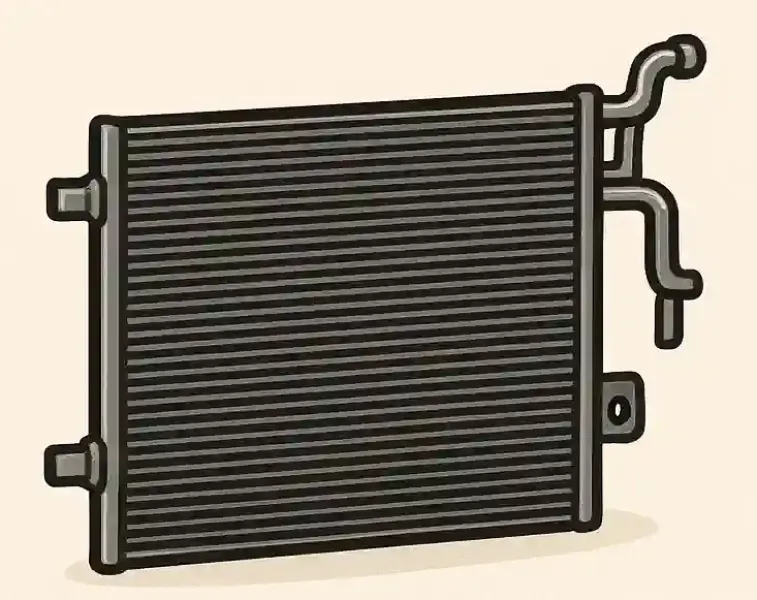
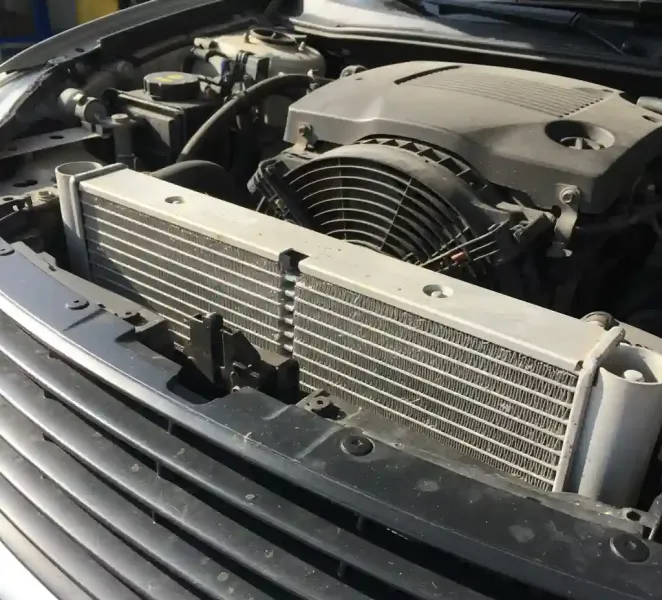
Air conditioning condenser
-
Part of the refrigeration circuit.
-
It is not an electrical component but a heat exchanger: it receives the hot refrigerant gas from the compressor and cools it down, turning it into liquid before it enters the evaporator.
-
Its proper operation is vital to maintaining cool air inside the cabin.
-
-
Electronic capacitors
-
Common in today’s cars, especially in control modules (ECU, audio systems, ABS, etc.).
-
They are used to filter electrical noise, stabilize voltages, and protect sensitive circuits from voltage spikes.
-
Symptoms of condenser failure
-
In old ignition systems: weak or missing spark, hard starting, engine misfiring, or power loss.
-
In air conditioning: poor cooling, compressor overheating, or visible dirt buildup on the condenser fins.
-
In electronic systems: erratic behavior in modules, displays, or other electrical systems.
Maintenance and care
-
Classic ignition: if the vehicle still uses contact points, it is advisable to replace the condenser when changing the points, since wear is inevitable.
-
Air conditioning: keep the external condenser clean, check for leaks, and avoid obstructions that could restrict airflow.
-
Electronics: usually require no direct maintenance; when they fail, the modules are generally replaced, although in some cases they can be repaired with specialized soldering.
Conclusion
The condenser, in its different applications, is a discreet but fundamental part of the automobile. Whether helping to generate a reliable spark in classic cars, ensuring comfort through air conditioning, or protecting modern electronics, its function guarantees proper performance and durability of various systems. Keeping it in good condition is an investment in the efficiency and safety of the vehicle.